Question:medium
Two particles of masses $m_1$ and $m_2$ ($m_1 > m_2$) are separated by a distance 'd'. When the positions of the two particles are interchanged, the shift in the centre of mass is:
Two particles of masses $m_1$ and $m_2$ ($m_1 > m_2$) are separated by a distance 'd'. When the positions of the two particles are interchanged, the shift in the centre of mass is:
Show Hint
The CM always shifts towards the heavier mass when they are swapped.
Updated On: Jun 10, 2026
- $\left(\frac{m_1 + m_2}{m_1 - m_2}\right)d$
- $\left(\frac{m_1 - m_2}{m_1 + m_2}\right)d$
- zero
- $\left(\frac{m_1}{m_1 - m_2}\right)d$
Show Solution
The Correct Option is B
Solution and Explanation
Step 1: Set up positions.
Two masses $m_1$ and $m_2$ (with $m_1 > m_2$) sit a distance $d$ apart. Place $m_1$ at position $0$ and $m_2$ at position $d$ on a line.
Step 2: Recall the centre of mass formula.
The centre of mass position is the mass weighted average: $x_{cm} = \dfrac{m_1 x_1 + m_2 x_2}{m_1 + m_2}$.
Step 3: Find the first centre of mass.
With $m_1$ at $0$ and $m_2$ at $d$: $x_{cm,1} = \dfrac{m_1(0) + m_2(d)}{m_1 + m_2} = \dfrac{m_2 d}{m_1 + m_2}$.
Step 4: Swap the masses.
Now put $m_2$ at $0$ and $m_1$ at $d$: $x_{cm,2} = \dfrac{m_2(0) + m_1(d)}{m_1 + m_2} = \dfrac{m_1 d}{m_1 + m_2}$.
Step 5: Find the shift.
The shift is the difference of the two centre positions: $|x_{cm,2} - x_{cm,1}| = \dfrac{(m_1 - m_2) d}{m_1 + m_2}$.
Step 6: Interpret it.
The centre of mass slides toward the side where the heavier mass now sits, by this amount. \[ \boxed{\left(\dfrac{m_1 - m_2}{m_1 + m_2}\right) d} \]
Two masses $m_1$ and $m_2$ (with $m_1 > m_2$) sit a distance $d$ apart. Place $m_1$ at position $0$ and $m_2$ at position $d$ on a line.
Step 2: Recall the centre of mass formula.
The centre of mass position is the mass weighted average: $x_{cm} = \dfrac{m_1 x_1 + m_2 x_2}{m_1 + m_2}$.
Step 3: Find the first centre of mass.
With $m_1$ at $0$ and $m_2$ at $d$: $x_{cm,1} = \dfrac{m_1(0) + m_2(d)}{m_1 + m_2} = \dfrac{m_2 d}{m_1 + m_2}$.
Step 4: Swap the masses.
Now put $m_2$ at $0$ and $m_1$ at $d$: $x_{cm,2} = \dfrac{m_2(0) + m_1(d)}{m_1 + m_2} = \dfrac{m_1 d}{m_1 + m_2}$.
Step 5: Find the shift.
The shift is the difference of the two centre positions: $|x_{cm,2} - x_{cm,1}| = \dfrac{(m_1 - m_2) d}{m_1 + m_2}$.
Step 6: Interpret it.
The centre of mass slides toward the side where the heavier mass now sits, by this amount. \[ \boxed{\left(\dfrac{m_1 - m_2}{m_1 + m_2}\right) d} \]
Was this answer helpful?
0
Top Questions on Centre of mass
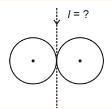
- Two solid spheres each of mass 2 kg and radius 75 cm are arranged as shown. Find MOI of the system about the given axis.
- JEE Main - 2024
- Physics
- Centre of mass
- Three blocks A, B and C are pulled on a horizontal smooth surface by a force of 80 N as shown in figure

The tensions T1 and T2 in the string are respectively:- JEE Main - 2024
- Physics
- Centre of mass
Find the value of m if \(M = 10\) \(kg\). All the surfaces are rough.
- JEE Main - 2024
- Physics
- Centre of mass
A non-uniform bar of weight W is suspended at rest by two strings of negligible weight as shown in Fig.6.33. The angles made by the strings with the vertical are 36.9° and 53.1° respectively. The bar is 2 m long. Calculate the distance d of the centre of gravity of the bar from its left end.

- CBSE Class XI
- Physics
- Centre of mass
- Want to practice more? Try solving extra ecology questions todayView All Questions