Question:medium
Two objects of masses \( 1\,\text{kg} \) and \( 2\,\text{kg} \) are moving towards each other with accelerations \( 2\,\text{m s}^{-2} \) and \( 3\,\text{m s}^{-2} \) respectively on a smooth horizontal surface. The acceleration of centre of mass of the system is
Two objects of masses \( 1\,\text{kg} \) and \( 2\,\text{kg} \) are moving towards each other with accelerations \( 2\,\text{m s}^{-2} \) and \( 3\,\text{m s}^{-2} \) respectively on a smooth horizontal surface. The acceleration of centre of mass of the system is
Show Hint
Always assign proper sign based on direction before applying formula.
Updated On: May 10, 2026
- \( \frac{4}{3}\,\text{m s}^{-2} \) in the direction of acceleration of 2 kg mass
- \( \frac{2}{3}\,\text{m s}^{-2} \) in the direction of acceleration of 1 kg mass
- \( \frac{2}{3}\,\text{m s}^{-2} \) in the direction of acceleration of 2 kg mass
- \( \frac{4}{3}\,\text{m s}^{-2} \) in the direction of acceleration of 1 kg mass
- zero
Show Solution
The Correct Option is A
Solution and Explanation
Step 1: Understanding the Concept:
The acceleration of the center of mass of a system of particles is determined by the vector sum of all external forces acting on the system and the total mass of the system. The internal forces between the particles do not affect the motion of the center of mass.
Step 2: Key Formula or Approach:
The acceleration of the center of mass (\(\vec{a}_{CM}\)) is given by: \[ \vec{a}_{CM} = \frac{m_1\vec{a}_1 + m_2\vec{a}_2 + \dots}{m_1 + m_2 + \dots} = \frac{\sum m_i \vec{a}_i}{\sum m_i} \] This can also be seen from Newton's second law for a system: \(\vec{F}_{net, ext} = M_{total} \vec{a}_{CM}\). Since \(\vec{F}_i = m_i \vec{a}_i\), the net external force is the sum of forces causing individual accelerations.
Step 3: Detailed Explanation:
Let \(m_1 = 1\) kg and \(m_2 = 2\) kg. The objects are moving "towards each other". Let's set up a one-dimensional coordinate system along the line of motion. Let the 1 kg mass be moving in the positive direction and the 2 kg mass in the negative direction.
Acceleration of the 1 kg mass: \(\vec{a}_1 = +2 \text{ ms}^{-2}\)
Acceleration of the 2 kg mass: \(\vec{a}_2 = -3 \text{ ms}^{-2}\) (The negative sign indicates it's in the opposite direction to \(\vec{a}_1\))
The total mass of the system is \(M_{total} = m_1 + m_2 = 1 + 2 = 3\) kg. Now, we use the formula for the acceleration of the center of mass: \[ \vec{a}_{CM} = \frac{m_1\vec{a}_1 + m_2\vec{a}_2}{m_1 + m_2} \] Substitute the values: \[ \vec{a}_{CM} = \frac{(1)(+2) + (2)(-3)}{1 + 2} = \frac{2 - 6}{3} = \frac{-4}{3} \text{ ms}^{-2} \] The result is \(\vec{a}_{CM} = -\frac{4}{3} \text{ ms}^{-2}\).
The magnitude of the acceleration of the center of mass is \(\frac{4}{3} \text{ ms}^{-2}\).
The negative sign indicates that the direction of \(\vec{a}_{CM}\) is the same as the direction of \(\vec{a}_2\) (the acceleration of the 2 kg mass).
Step 4: Final Answer:
The acceleration of the centre of mass is \((\frac{4}{3}) ms^{-2}\) in the direction of the acceleration of the 2 kg mass.
The acceleration of the center of mass of a system of particles is determined by the vector sum of all external forces acting on the system and the total mass of the system. The internal forces between the particles do not affect the motion of the center of mass.
Step 2: Key Formula or Approach:
The acceleration of the center of mass (\(\vec{a}_{CM}\)) is given by: \[ \vec{a}_{CM} = \frac{m_1\vec{a}_1 + m_2\vec{a}_2 + \dots}{m_1 + m_2 + \dots} = \frac{\sum m_i \vec{a}_i}{\sum m_i} \] This can also be seen from Newton's second law for a system: \(\vec{F}_{net, ext} = M_{total} \vec{a}_{CM}\). Since \(\vec{F}_i = m_i \vec{a}_i\), the net external force is the sum of forces causing individual accelerations.
Step 3: Detailed Explanation:
Let \(m_1 = 1\) kg and \(m_2 = 2\) kg. The objects are moving "towards each other". Let's set up a one-dimensional coordinate system along the line of motion. Let the 1 kg mass be moving in the positive direction and the 2 kg mass in the negative direction.
Acceleration of the 1 kg mass: \(\vec{a}_1 = +2 \text{ ms}^{-2}\)
Acceleration of the 2 kg mass: \(\vec{a}_2 = -3 \text{ ms}^{-2}\) (The negative sign indicates it's in the opposite direction to \(\vec{a}_1\))
The total mass of the system is \(M_{total} = m_1 + m_2 = 1 + 2 = 3\) kg. Now, we use the formula for the acceleration of the center of mass: \[ \vec{a}_{CM} = \frac{m_1\vec{a}_1 + m_2\vec{a}_2}{m_1 + m_2} \] Substitute the values: \[ \vec{a}_{CM} = \frac{(1)(+2) + (2)(-3)}{1 + 2} = \frac{2 - 6}{3} = \frac{-4}{3} \text{ ms}^{-2} \] The result is \(\vec{a}_{CM} = -\frac{4}{3} \text{ ms}^{-2}\).
The magnitude of the acceleration of the center of mass is \(\frac{4}{3} \text{ ms}^{-2}\).
The negative sign indicates that the direction of \(\vec{a}_{CM}\) is the same as the direction of \(\vec{a}_2\) (the acceleration of the 2 kg mass).
Step 4: Final Answer:
The acceleration of the centre of mass is \((\frac{4}{3}) ms^{-2}\) in the direction of the acceleration of the 2 kg mass.
Was this answer helpful?
0
Top Questions on Centre of mass
- Two solid spheres each of mass 2 kg and radius 75 cm are arranged as shown. Find MOI of the system about the given axis.
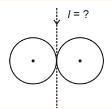
- JEE Main - 2024
- Physics
- Centre of mass
- Three blocks A, B and C are pulled on a horizontal smooth surface by a force of 80 N as shown in figure

The tensions T1 and T2 in the string are respectively:- JEE Main - 2024
- Physics
- Centre of mass
Find the value of m if \(M = 10\) \(kg\). All the surfaces are rough.
- JEE Main - 2024
- Physics
- Centre of mass
A non-uniform bar of weight W is suspended at rest by two strings of negligible weight as shown in Fig.6.33. The angles made by the strings with the vertical are 36.9° and 53.1° respectively. The bar is 2 m long. Calculate the distance d of the centre of gravity of the bar from its left end.

- CBSE Class XI
- Physics
- Centre of mass
- Want to practice more? Try solving extra ecology questions todayView All Questions
