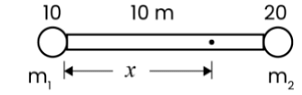
Two objects of mass 10 kg and 20 kg respectively are connected to the two ends of a rigid rod of length 10 m with negligible mass. The distance of the center of mass of the system from the 10 kg mass is:
Step 1: Understanding the Concept:
The center of mass of a system of particles is a specific point at which the entire mass of the system can be considered to be concentrated for describing its motion.
For a two-particle system, the center of mass lies on the line joining the two particles. Key Formula or Approach:
If we place one mass \(m_1\) at the origin (\(x_1 = 0\)) and another mass \(m_2\) at a distance \(L\) (\(x_2 = L\)), the position of the center of mass \(X_{cm}\) from \(m_1\) is:
\[ X_{cm} = \frac{m_1x_1 + m_2x_2}{m_1 + m_2} \] Step 2: Detailed Explanation:
Given:
- \(m_1 = 10 \text{ kg}\) (placed at \(x_1 = 0\))
- \(m_2 = 20 \text{ kg}\)
- Length of rod \(L = 10 \text{ m}\) (so \(x_2 = 10 \text{ m}\))
Substitute the values into the formula:
\[ X_{cm} = \frac{(10 \times 0) + (20 \times 10)}{10 + 20} \]
\[ X_{cm} = \frac{0 + 200}{30} \]
\[ X_{cm} = \frac{200}{30} \]
\[ X_{cm} = \frac{20}{3} \text{ m} \]
This value \(\frac{20}{3} \text{ m}\) is the distance from the origin, which is where the 10 kg mass is located. Step 3: Final Answer:
The distance of the center of mass from the 10 kg mass is \(\frac{20}{3} \text{ m}\).