Question:medium
The $\alpha$-D-glucose and $\beta$-D-glucose differ from each other due to difference in carbon atom with respect to its
The $\alpha$-D-glucose and $\beta$-D-glucose differ from each other due to difference in carbon atom with respect to its
Updated On: Jun 24, 2026
- conformation
- configuration
- number of OH-groups
- size of hemiacetal ring
Show Solution
The Correct Option is C
Solution and Explanation
The question asks about the difference between $\alpha$-D-glucose and $\beta$-D-glucose. To understand this, we must explore the concept of anomers in carbohydrate chemistry.
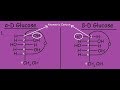
Glucose is an aldohexose, which means it has an aldehyde group and six carbon atoms. When D-glucose forms a cyclic structure, it can form two isomers known as anomers, namely $\alpha$-D-glucose and $\beta$-D-glucose. These isomers differ at the anomeric carbon (C-1 position in the case of glucose).
Here is the difference between $\alpha$-D-glucose and $\beta$-D-glucose:
- Configuration: The configuration at the anomeric carbon is different. In $\alpha$-D-glucose, the OH group at C-1 is on the opposite side (trans) of the CH2OH group. In contrast, in $\beta$-D-glucose, the OH group at C-1 is on the same side (cis) as the CH2OH group.
- Number of OH-groups: The number of hydroxyl (OH) groups in both $\alpha$-D-glucose and $\beta$-D-glucose is the same; they both have five OH groups. This is a critical point as this option was mentioned in the question but is incorrect.
Given the options provided, let's analyze which is the correct answer:
- Conformation: This usually refers to the spatial arrangement of atoms which can change without breaking bonds. Anomers are due to configurational changes, not conformational.
- Configuration: Correct, as explained, the $\alpha$ and $\beta$ forms differ in the configuration of their anomeric carbon.
- Number of OH-groups: Incorrect, since both forms have the same number of hydroxyl groups.
- Size of hemiacetal ring: This remains unchanged between $\alpha$ and $\beta$ forms.
Based on this analysis, the correct answer is configuration.
Was this answer helpful?
0
Learn with videos:
Top Questions on Biomolecules
- Identify linear polymer from following
- MHT CET - 2025
- Biology
- Biomolecules
- Lanthanoid which has the smallest size in \( +3 \) state is:
- VITEEE - 2024
- Chemistry
- Biomolecules
- Specific conductance of 0.1 M HNO\(_3\) is \(6.3 \times 10^{-2} \, \text{ohm}^{-1} \, \text{cm}^{-1}\). The molar conductance of the solution is:
- VITEEE - 2024
- Chemistry
- Biomolecules
- Nucleotides are composed of:
- CBSE Class XII - 2024
- Chemistry
- Biomolecules
- Want to practice more? Try solving extra ecology questions todayView All Questions

