Show that a.(b × c) is equal in magnitude to the volume of the parallelepiped formed on the three vectors , a, b and c.
Solution and Explanation
A parallelepiped with origin O and sides a, b, and c is shown in the following figure.

Volume of the given parallelepiped = abc
\(\vec {OC} = \vec a\)
\(\vec {OB} = \vec b\)
\(\vec {OC} = \vec c\)
Let be a unit vector perpendicular to both b and c. Hence, n^ and a have the same direction.
∴ \(\vec b\) × \(\vec c\) = bc sinθ \(\^n\)
= bc sin 90° \(\^n\)
= bc\(\^n\)
\(\vec a.(\vec b × \vec c) \)
=\(a.(bc\^n) \)
= abc cosθ \(\^n\)
= abc cos 0°
= abc
= Volume of the parallelepiped
Top Questions on Centre of mass
- Two solid spheres each of mass 2 kg and radius 75 cm are arranged as shown. Find MOI of the system about the given axis.
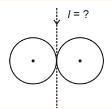
- JEE Main - 2024
- Physics
- Centre of mass
- Three blocks A, B and C are pulled on a horizontal smooth surface by a force of 80 N as shown in figure

The tensions T1 and T2 in the string are respectively:- JEE Main - 2024
- Physics
- Centre of mass
Find the value of m if \(M = 10\) \(kg\). All the surfaces are rough.
- JEE Main - 2024
- Physics
- Centre of mass
A non-uniform bar of weight W is suspended at rest by two strings of negligible weight as shown in Fig.6.33. The angles made by the strings with the vertical are 36.9° and 53.1° respectively. The bar is 2 m long. Calculate the distance d of the centre of gravity of the bar from its left end.

- CBSE Class XI
- Physics
- Centre of mass
- Want to practice more? Try solving extra ecology questions todayView All Questions