Make a diagram to show how hypermetropia is corrected. The near point of a hypermetropic eye is 1 m. What is the power of the lens required to correct this defect? Assume that the near point of the normal eye is 25 cm.
Solution and Explanation
Hypermetropia, or farsightedness, is a vision condition where distant objects are seen clearly, but near objects appear blurry. This occurs because the eye's lens focuses incoming light rays, which diverge from near objects, behind the retina. A convex lens corrects this defect by converging light rays so that the image forms on the retina, as illustrated in the accompanying figure.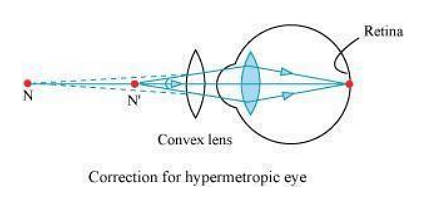
The convex lens effectively creates a virtual image (N') of a near object at the person's natural near point of vision (N). If the near point of a normal eye is 25 cm, and the hypermetropic individual's near point is 1 m, they can see an object at 25 cm clearly if its image is formed at 1 m.
Object distance, u = −25 cm
Image distance, v = −1 m = −100 cm
Focal length, f
Applying the lens formula:
\(\frac{1}{v}-\frac{1}{u}=\frac{1}{f}\)
\(\frac{1}{-100}-\frac{1}{-25}=\frac{1}{f}\)
\(⇒\frac{1}{f}=\frac{1}{25}-\frac{1}{100}\)
\(⇒\frac{1}{f}=\frac{4-1}{100}\)
\(⇒f=\frac{100}{3} \approx 33.3\) cm
\(\approx 0.33\) m
∴\text{Power, P}=\frac{1}{f}\text{(in metres)}\)
\(=\frac{1}{0.33} \approx +3.0\) D
A convex lens with a power of +3.0 D is required to correct this vision impairment.
Top Questions on Defects Of Vision And Their Correction
- What is meant by power of accommodation of the eye?
- CBSE Class X
- Science
- Defects Of Vision And Their Correction
- A person with a myopic eye cannot see objects beyond 1.2 m distinctly. What should be the type of the corrective lens used to restore proper vision?
- CBSE Class X
- Science
- Defects Of Vision And Their Correction
- What is the far point and near point of the human eye with normal vision?
- CBSE Class X
- Science
- Defects Of Vision And Their Correction
- A student has difficulty reading the blackboard while sitting in the last row. What could be the defect the child is suffering from? How can it be corrected?
- CBSE Class X
- Science
- Defects Of Vision And Their Correction
- Want to practice more? Try solving extra ecology questions todayView All Questions