Question:medium
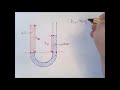
In a u-tube as shown in figure, water and oil are in the left side and right side of the tube respectively. The heights from the bottom for water and oil columns are 15 cm and 20 cm respectively. The density of the oil is :- [take \(\rho_{water}\) = 1000 kg/m\(^3\)]
In a u-tube as shown in figure, water and oil are in the left side and right side of the tube respectively. The heights from the bottom for water and oil columns are 15 cm and 20 cm respectively. The density of the oil is :- [take \(\rho_{water}\) = 1000 kg/m\(^3\)]
Updated On: Jun 25, 2026
- 1200 kg/m$^3$
- 750 kg/m$^3$
- 1000 kg/m$^3$
- 1333 kg/m$^3$
Show Solution
The Correct Option is B
Solution and Explanation
To find the density of the oil in the U-tube setup, we need to consider the principle of hydrostatic equilibrium, which states that the pressure exerted by a fluid column at a specific height is equal across the U-tube.
Given:
- Height of water column, h_{\text{water}} = 15 \text{ cm} = 0.15 \text{ m}
- Density of water, \rho_{\text{water}} = 1000 \text{ kg/m}^{3}
- Height of oil column, h_{\text{oil}} = 20 \text{ cm} = 0.20 \text{ m}
- Density of oil, \rho_{\text{oil}} (to be determined)
In equilibrium, the pressure at the bottom of both sides must be the same:
P_{\text{water}} = P_{\text{oil}}
The pressure due to a fluid column is given by P = \rho g h.
So for the water column:
P_{\text{water}} = \rho_{\text{water}} \cdot g \cdot h_{\text{water}}
For the oil column:
P_{\text{oil}} = \rho_{\text{oil}} \cdot g \cdot h_{\text{oil}}
Setting these pressures equal gives:
\rho_{\text{water}} \cdot g \cdot h_{\text{water}} = \rho_{\text{oil}} \cdot g \cdot h_{\text{oil}}
Cancelling out g from both sides, we get:
\rho_{\text{water}} \cdot h_{\text{water}} = \rho_{\text{oil}} \cdot h_{\text{oil}}
Substituting the given values:
1000 \cdot 0.15 = \rho_{\text{oil}} \cdot 0.20
Simplifying, we find:
\rho_{\text{oil}} = \frac{1000 \cdot 0.15}{0.20}
\rho_{\text{oil}} = \frac{150}{0.20}
\rho_{\text{oil}} = 750 \text{ kg/m}^{3}
Therefore, the density of the oil is 750 kg/m3.
Answer: 750 kg/m3
Was this answer helpful?
1
Learn with videos:
Top Questions on Bernauli Theorem
- Water flows in a streamline motion through a horizontal pipe of circular cross-section as shown in the figure. The pressure difference of water between \(P\) and \(Q\) is \(15\,\text{N m}^{-2}\). The area of cross-section at \(P\) and \(Q\) are \(40\,\text{cm}^2\) and \(20\,\text{cm}^2\), respectively. The rate of flow of water through the pipe, in \(\text{cm}^3\text{s}^{-1}\), is:

- NEET (UG) - 2026
- Physics
- Bernauli Theorem
- Water flows at $3~ms^{-1}$ in a horizontal pipe under a pressure of $2\times10^{5}~Nm^{-2}$. The pipe narrows to half its original diameter at one end. The speed of water (in $ms^{-1}$) in this narrow section is ________.
- KEAM - 2025
- Physics
- Bernauli Theorem
- Want to practice more? Try solving extra ecology questions todayView All Questions

