If external force acting on a body is zero, centre of mass of body
Show Hint
- decreases
- remains constant
- increases
- first increases then decreases
The Correct Option is B
Solution and Explanation
Understanding the Concept:
The question is related to the concept of the motion of the center of mass (COM) in physics. Specifically, it examines the behavior of the center of mass of a body when no external forces are acting on it.
The Center of Mass of a Body:
The center of mass is a point representing the mean position of the matter in a body or system. The motion of the center of mass (COM) of a system of particles is governed by Newton's second law of motion.
Newton's Second Law for the Center of Mass:
According to Newton’s second law, the acceleration of the center of mass is directly proportional to the net external force acting on the system and is given by:
\(F_{\text{ext}} = M \cdot a_{\text{com}}\)
where \(F_{\text{ext}}\) is the external force acting on the system, \(M\) is the total mass of the system, and \(a_{\text{com}}\) is the acceleration of the center of mass.
Analysis of the Given Options:
- Decreases: If the external force acting on the body is zero, there is no acceleration. Thus, the center of mass does not decrease in velocity on its own.
- Remains Constant: With zero external force, the acceleration of the center of mass is zero (\(a_{\text{com}} = 0\)). Therefore, the velocity and position of the center of mass remain constant over time. This means the motion of the center of mass does not change if unperturbed by external forces.
- Increases: Without an external force, there is no increase in acceleration; hence, the velocity or position of the center of mass cannot increase intrinsically.
- First Increases then Decreases: This option suggests a fluctuation in motion which is not possible without external forces causing acceleration and deceleration.
Conclusion:
The only correct option is "remains constant" because it accurately reflects the state of a system's center of mass when the external forces acting upon it are zero.
Top Questions on Centre of mass
- Two solid spheres each of mass 2 kg and radius 75 cm are arranged as shown. Find MOI of the system about the given axis.
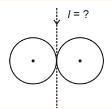
- JEE Main - 2024
- Physics
- Centre of mass
- Three blocks A, B and C are pulled on a horizontal smooth surface by a force of 80 N as shown in figure

The tensions T1 and T2 in the string are respectively:- JEE Main - 2024
- Physics
- Centre of mass
Find the value of m if \(M = 10\) \(kg\). All the surfaces are rough.
- JEE Main - 2024
- Physics
- Centre of mass
A non-uniform bar of weight W is suspended at rest by two strings of negligible weight as shown in Fig.6.33. The angles made by the strings with the vertical are 36.9° and 53.1° respectively. The bar is 2 m long. Calculate the distance d of the centre of gravity of the bar from its left end.

- CBSE Class XI
- Physics
- Centre of mass
- Want to practice more? Try solving extra ecology questions todayView All Questions
