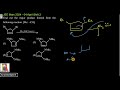
Step 1: \( S_N2 \) reaction with dimethylamine (\( \text{Me}_2\text{NH} \)) replaces a bromine atom with \( \text{Me}_2\text{N} \), creating an intermediate with a quaternary amine on an adjacent carbon. Step 2: Deprotonation of the intermediate yields an alkene. Step 3: A second \( S_N2 \) reaction with dimethylamine substitutes the remaining bromine atom with another \( \text{Me}_2\text{N} \) group. The final product features two \( \text{Me}_2\text{N} \) groups at adjacent positions on the cyclopentane ring. This mechanism applies to both cis and trans isomers, resulting in identical products.