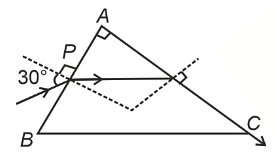
Step 1: Deviation and Incidence Angles
In a prism, the deviation angle \( \delta \) depends on the incidence angle \( i \). This relation is key to understanding light refraction in the prism. Typically, the deviation decreases as the incidence angle increases, reaching a minimum \( \delta_{\text{min}} \), then rises again.
The deviation angle formula is:
\[
\delta = i + r - A
\]
Where:
- \( i \) is the incidence angle,
- \( r \) is the refraction angle inside the prism,
- \( A \) is the prism angle.
Step 2: Minimum Deviation
The graph probably shows this, plotting deviation against incidence. At minimum deviation, the deviation is smallest, and the light ray passes symmetrically. The incidence angle \( i_m \) at this point is the minimum angle of incidence.
Step 3: Conclusion
From the graph, minimum deviation occurs when the incidence angle \( i \) is minimal. Based on the options, this corresponds to:
\[
\boxed{(B)} \, 60^\circ
\]