All the components of the nodal tissue are autoexcitable. Why does the SA node act as the normal pacemakar?
- SA node has the lowest rate of depolarisation.
- SA node is the only component to generate the threshold potential.
- Only SA node can convey the action potential to the other components.
- SA node has the highest rate of depolarisation.
The Correct Option is D
Solution and Explanation
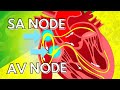
The Sinoatrial (SA) node, also known as the sinoatrial node or sinus node, is considered the natural pacemaker of the heart. This is because it initiates the electrical impulses that determine the heart rate. Let's analyze why the SA node acts as the normal pacemaker and examine the given options:
- SA node has the lowest rate of depolarisation: This statement is false. The SA node actually has the highest rate of depolarization compared to other components of the nodal tissue. Therefore, this option is incorrect.
- SA node is the only component to generate the threshold potential: This is incorrect. Other components of the nodal tissue, such as the AV node, can also generate threshold potentials. However, the SA node reaches the threshold potential more quickly due to its higher rate of depolarization.
- Only SA node can convey the action potential to the other components: This statement is misleading. Although the SA node initiates the electrical activity, the action potential is conveyed through a network that includes the AV node, Bundle of His, and Purkinje fibers.
- SA node has the highest rate of depolarisation: This is the correct answer. The SA node depolarizes more quickly than other parts of the nodal tissue, setting the pace for the entire heart. This intrinsic property makes it the primary pacemaker.
The SA node's ability to depolarize at a higher rate ensures that it consistently reaches the threshold potential first, triggering an action potential that spreads throughout the heart, initiating each heartbeat. This rapid rate of depolarization is due to a higher permeability to sodium ions, leading to a faster rate of spontaneous depolarization compared to other nodal cells. Thus, it acts as the dominant pacemaker under normal physiological conditions.
Learn with videos:
Top Questions on Circulatory Pathways
- Which of the following is true about the pulmonary artery in the human circulatory system?
- MHT CET - 2024
- Biology
- Circulatory Pathways
- How do most arthropods circulate nutrients and gases throughout their bodies?
- MHT CET - 2024
- Biology
- Circulatory Pathways
- What is the function of the human heart's left ventricle?
- MHT CET - 2025
- Biology
- Circulatory Pathways
- Which of the following is the primary function of red blood cells?
- MHT CET - 2025
- Biology
- Circulatory Pathways
- Want to practice more? Try solving extra ecology questions todayView All Questions

