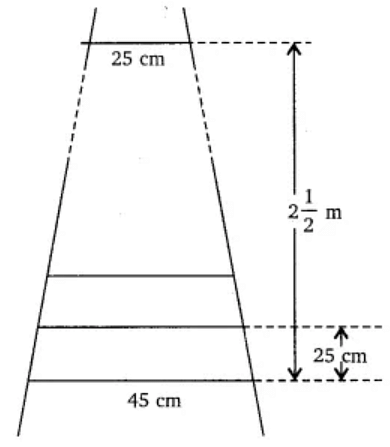
A ladder has rungs 25 cm apart. (see Fig. 5.7). The rungs decrease uniformly in length from 45 cm at the bottom to 25 cm at the top. If the top and the bottom rungs are \(2\frac 12\) m apart, what is the length of the wood required for the rungs?Fig. 5.7
The rungs are spaced 25 cm apart. The distance between the top and bottom rungs is \(2\frac 12\) m.
The total number of rungs is calculated as \(\frac {2\frac 12 \times 100}{25} +1\), which equals \(\frac {250}{25} + 1 = 11\).
Since the lengths of the rungs decrease uniformly, they form an arithmetic progression (A.P.).
The total length of wood required for the rungs is the sum of this A.P.
The first term (longest rung) is \(a = 45\) cm.
The last term (shortest rung) is \(l = 25\) cm.
The number of terms is \(n = 11\).
The sum of an A.P. is given by \(S_n = \frac n2(a+l)\).
Substituting the values, \(S_{10} = \frac {11}{2}(45+25)\).
This simplifies to \(S_{10}= \frac {11}{2} (70)\), resulting in \(S_{10}= 385\) cm.
Therefore, the total length of wood required is 385 cm.