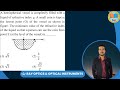
A hemispherical vessel is completely filled with a liquid of refractive index \( \mu \). A small coin is kept at the lowest point \( O \) of the vessel as shown in the figure. The minimum value of the refractive index of the liquid so that a person can see the coin from point \( E \) (at the level of the vessel) is:
Show Hint
To find the minimum refractive index, use the critical angle condition, where the angle of incidence equals the critical angle.
For visibility, the critical condition requires calculating the maximum refraction angle, \(\theta_r\), as light leaves the liquid surface.
Snell's Law states: \[ \mu \sin(\theta_i) = 1 \cdot \sin(90^\circ) = \mu \cdot \sin(\theta_i) \] This simplifies to: \[ \sin(\theta_i) = \frac{1}{\mu} \]
Maximum visibility occurs when light refracts horizontally at \(90^\circ\). Therefore, the angle of incidence must not exceed the critical angle: \[ \sin(\theta_i) = \frac{1}{\mu} \Rightarrow \theta_i = \sin^{-1}\left(\frac{1}{\mu}\right) \]
The light path from \(O\) to \(E\) forms a right triangle. The hypotenuse is the vessel's radius, and the vertical leg is the hemisphere. Geometric relationships yield: \[ \sin(\theta_i) = \frac{R}{R\sqrt{2}} = \frac{1}{\sqrt{2}} \]
Equating the expressions for \(\sin(\theta_i)\): \[ \frac{1}{\mu} = \frac{1}{\sqrt{2}} \]
Solving for \(\mu\): \[ \mu = \sqrt{2} \]
Consequently, the minimum refractive index of the liquid for the coin to be visible from \(E\) is \(\sqrt{2}\).