A gas is taken through the cycle \(A \rightarrow B \rightarrow C \rightarrow A,\) as shown. What is the net work done by the gas?
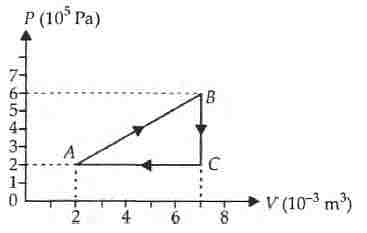
A gas is taken through the cycle \(A \rightarrow B \rightarrow C \rightarrow A,\) as shown. What is the net work done by the gas?
- Zero
- -2000 J
- 2000 J
- 1000 J
The Correct Option is D
Solution and Explanation
To calculate the net work done by the gas in the cycle \(A \rightarrow B \rightarrow C \rightarrow A\), we need to understand the nature of each process involved in the cycle as displayed in the pressure-volume (P-V) diagram.
The net work done by the gas in a cycle is equal to the area enclosed by the cycle on the P-V diagram. Let's break down each step:
- Process \(A \rightarrow B\): This is an isochoric (constant volume) process. Since the volume doesn't change, no work is done in this process.
- Process \(B \rightarrow C\): This is an isobaric (constant pressure) process with pressure \(P_B = P_C = 7 \times 10^5 \, \text{Pa}\).
- \(V_C = 8 \times 10^{-3}\, \text{m}^3\)
- \(V_B = 4 \times 10^{-3}\, \text{m}^3\)
- Process \(C \rightarrow A\): This is another isobaric process, with pressure \(P_C = P_A = 3 \times 10^5 \, \text{Pa}\).
- \(V_A = 2 \times 10^{-3}\, \text{m}^3\)
- \(V_C = 8 \times 10^{-3}\, \text{m}^3\)
The net work done by the gas in the cycle is the algebraic sum of the work done in each process:
\(W_{\text{net}} = W_{BC} + W_{CA} = 2800 + (-1800) = 1000 \, \text{J}\)
Thus, the correct answer is 1000 J.
Top Questions on Thermodynamics
A real gas within a closed chamber at \( 27^\circ \text{C} \) undergoes the cyclic process as shown in the figure. The gas obeys the equation \( PV^3 = RT \) for the path A to B. The net work done in the complete cycle is (assuming \( R = 8 \, \text{J/molK} \)):

- MHT CET - 2024
- Physics
- Thermodynamics
- Two vessels \( A \) and \( B \) are of the same size and are at the same temperature. Vessel \( A \) contains \( 1 \, \text{g} \) of hydrogen and vessel \( B \) contains \( 1 \, \text{g} \) of oxygen. \( P_A \) and \( P_B \) are the pressures of the gases in \( A \) and \( B \) respectively. Then \( \frac{P_A}{P_B} \) is:
- MHT CET - 2024
- Physics
- Thermodynamics
- A mixture of one mole of monoatomic gas and one mole of diatomic gas (rigid) are kept at room temperature (\( 27^\circ \text{C} \)). The ratio of specific heat of gases at constant volume respectively is:
- MHT CET - 2024
- Physics
- Thermodynamics
- If the activation energy for the forward reaction is \( 150 \, \text{kJ/mol} \) and that of the reverse reaction is \( 260 \, \text{kJ/mol} \), what is the enthalpy change for the reaction?
- MHT CET - 2024
- Chemistry
- Thermodynamics
- Want to practice more? Try solving extra ecology questions todayView All Questions

